Article

Exploring Functional Brain Networks in Alzheimer’s Disease Using Resting State EEG Signals


by
Vangelis P. Oikonomou
*,
Kostas Georgiadis
,
Ioulietta Lazarou
,
Spiros Nikolopoulos
,
Ioannis Kompatsiaris
and
PREDICTOM Consortium
Information Technologies Institute, Centre for Research and Technology Hellas, CERTH-ITI, 6th km Charilaou-Thermi Road, 57001 Thessaloniki, Greece
*
Author to whom correspondence should be addressed.
IHI JU No 101132356, UKRI No 10083467, KCL 10083181, Exeter No 10091560, Geneva SERI No 113152304. The members are listed in the Acknowledgments.
J. Dement. Alzheimer's Dis. 2025, 2(2), 12; https://doi.org/10.3390/jdad2020012
Submission received: 17 January 2025 / Revised: 7 March 2025 / Accepted: 22 April 2025 / Published: 2 May 2025

Abstract

Background/Objectives: Alzheimer’s disease (AD) is a progressive neurodegenerative disorder that disrupts functional brain connectivity, leading to cognitive and functional decline. Electroencephalography (EEG), a noninvasive and cost-effective technique, has gained attention as a promising tool for studying brain network alterations in AD. This study aims to leverage EEG-derived connectivity metrics to differentiate between healthy controls (HC), subjective cognitive decline (SCD), mild cognitive impairment (MCI), and AD, offering insights into disease progression. Methods: Using graph theory-based analysis, we extracted key connectivity metrics from resting-state EEG signals, focusing on the betweenness centrality and clustering coefficient. Statistical analysis was conducted across multiple EEG frequency bands, and discriminant analysis was applied to evaluate the classification performance of connectivity metrics. Results: Our findings revealed a progressive increase in theta-band betweenness centrality and a concurrent decrease in alpha- and beta-band centrality, reflecting AD-related network reorganization. Among the examined metrics, theta-band betweenness centrality exhibited the highest discriminative power in distinguishing AD stages. Additionally, classification performance using connectivity metrics was comparable to advanced deep learning models, highlighting their potential as predictive biomarkers. Conclusions: EEG-derived connectivity metrics demonstrate strong potential as noninvasive biomarkers for the early detection and monitoring of AD progression. Their effectiveness in capturing network alterations underscores their value in clinical diagnostic workflows, offering a scalable and interpretable alternative to deep learning-based models for AD classification.

1. Introduction

Alzheimer’s disease (AD) is a progressive and irreversible condition during which neurons lose their function and connections over time, resulting in the deterioration of cognitive abilities, such as reasoning, memory, and sense of direction [1,2,3]. Before being diagnosed with AD, individuals often progress through various stages or phases marked by the gradual deterioration of brain functions. Mild cognitive impairment (MCI) is considered an intermediate phase between normal aging and AD, and evidence shows that, each year, approximately 8–15% of MCI patients develop AD [2,4,5]. Individuals with MCI have minor cognitive impairments that do not significantly interfere with their daily activities; therefore, MCI is often overlooked and misrecognized as a manifestation of normal aging. However, studies indicate that MCI patients progress to AD earlier than healthy individuals of the same age. Therefore, early MCI detection is essential for controlling disease progression and delaying interference with daily activities. Particularly, nonamnestic MCI (naMCI) is often confused with normal aging because it lacks the representative AD symptom, memory decline. Additionally, Subjective Cognitive Decline (SCD) is an intermediate step between normal aging and MCI, and it is crucial for the prediction or early detection of MCI, which determines the presence of AD spectrum pathology [4,6,7]. In the SCD stage (or phase), individuals experience a subjective decrease in cognitive function, but cognitive performance by neuropsychological testing and in daily functioning shows no evidence of objective cognitive impairment. In clinical practice, these individuals are generally considered healthy [6]. Hence, the identification of SCD, as well as its determination of importance for the specific individual (i.e., will lead to AD or not?), represents the most difficult task in AD research. Therefore, developing predictive models for differential diagnosis across the AD spectrum is essential for early intervention and for identifying individuals at high risk of progressing to more severe stages of Alzheimer’s disease. In this context, electroencephalography (EEG) is a good alternative for low-cost, noninvasive, and user-friendly detection tools [8,9]. As a biomarker for neurodegenerative diseases, EEG has recently received significant attention [10,11,12,13].
The human brain is a complex network of neural circuits, and many aspects of its detailed design are unknown. To explore the brain system, not only is the information about the system’s components required, but also we have to know how these components interact with each other. To this end, mathematical and computational principles of graph theory are applied to neurophysiological data in order to achieve valuable information about the organization and interactions of brain areas [14]. These networks can be studied under the concept of functional connectivity [14,15,16], which measures the statistical relationship between the activity of different brain regions over time. By analyzing how brain regions communicate during tasks or at rest, we can gain insights into how different networks coordinate to perform specific functions, such as memory, attention, or sensory processing [3]. Abnormalities in the network structure of the brain have been frequently linked to various brain disorders such as dementia, multiple sclerosis, and and traumatic brain injury [14,17].
A brain network represents the brain as a system of interconnected regions, where each region is modeled as a node and the connections between them as edges. These connections are derived from functional relationships, such as statistical dependencies between signals recorded at different scalp locations [16,18]. Graph theory plays a fundamental role by providing the mathematical framework to model and analyze the brain network. Formally, a brain network can be represented as a graph  G = V , E , where V is the set of nodes (representing brain regions or EEG channels), and E is the set of edges (representing functional connections between the nodes). An adjacency matrix  A  is often used to describe the network, where each element  a ij  of the matrix corresponds to the strength of the connection (edge) between nodes  i  and  j . In a binary graph,  a ij = 1  if a connection exists between nodes  i  and  j , and  a ij = 0  otherwise. In weighted networks,  a ij  can take continuous values that represent the strength of the connection, such as the degree of synchronization or correlation between EEG signals.
Previous studies have shown that properties of EEG-based functional networks are significantly altered in brain disorders such as Alzheimer’s disease (AD) [11,12,13,19,20]. AD, the most common form of neurodegenerative dementia, is characterized by progressive cognitive decline, including disruptions in memory recall, thinking, behavior, and the ability to perform daily activities [21]. In the context of brain networks, AD leads to profound alterations in network properties such as synchronizability, small-worldness, average path length, and clustering coefficient, which differentiate AD-affected networks from those of healthy individuals [15,22,23]. These metrics provide valuable insights into how the disease impacts both local and global connectivity. Understanding these connectivity phenomena is crucial for identifying early biomarkers and advancing strategies for diagnosis and intervention.
The process of constructing brain functional networks involves the determination of functional connectivity between brain regions. Techniques such as correlation, coherence, phase synchronization, and synchronization likelihood are commonly employed to derive connectivity matrices from EEG signals. These measures capture distinct aspects of brain region interactions, from linear associations (correlation) to frequency-specific synchrony (coherence) and phase relationships (phase synchronization) [13,21,22,24,25,26]. The resulting connectivity matrices are typically undirected, reflecting the bidirectional nature of neural communication captured by these techniques [16]. These undirected functional networks provide the foundation for further analysis using graph theory, enabling researchers to quantify network properties and investigate how brain connectivity is altered in AD. Such analyses are essential for understanding the structural and functional reorganization of the brain in the context of neurodegeneration, offering critical insights into the mechanisms underlying AD progression.
The contributions of our work are related to the following:
  • The examination of the usefulness of resting EEG signals, under the functional connectivity concept, to discriminate between HC and SCD using a large cohort of subjects (∼1000).
  • The evaluation of connectivity metrics over the entire AD spectrum, including people from the SCD group, by performing statistical analysis and discriminant analysis.
  • In most works, few graph metrics were reported in common, precluding meta-analyses. In our analysis, we include a large number of metrics; hence, we provide a holistic view of our study with respect to brain’s connectivity.
  • Finally, we provide a holistic view of data analysis by incorporating statistical analysis, topographical visualization, and predictive analysis.

2. Materials and Methods

2.1. Subjects

The CAUEEG dataset includes EEG recordings from 1155 participants [27]. These recordings come with detailed clinical annotations and event histories, providing comprehensive data for training and evaluating data analysis. Patients were diagnosed with normal, mild cognitive impairment (MCI), or dementia based on a combination of the following: clinical assessments including detailed medical history, physical examinations, cognitive tests, neuroimaging with MRI or CT scans to observe the brain structure and rule out other conditions, and blood tests to exclude other causes of cognitive impairment. These comprehensive evaluations help in accurately classifying subjects into HC, MCI, or AD groups. It is important to note that the HC group also includes individuals with SCD, who, in our study, were treated as a distinct group. Additionally, the distribution of participants across AD, MCI, SCD, and HC groups (and subgroups) is available in Figure 2 of [27].

2.2. EEG Recordings

This dataset’s EEG recordings include 21 channels, with 19 dedicated to EEG and the remaining 2 for the electrocardiogram (EKG/ECG) and photic stimulation. The EEG was conducted using the International 10–20 system, placing electrodes at Fp1, F3, C3, P3, O1, Fp2, F4, C4, P4, O2, F7, T3, T5, F8, T4, T6, FZ, CZ, and PZ, with linked earlobe referencing. Subjects were recorded while lying awake in bed, under the supervision of a hospital technician. The signals were filtered with a 0.5–70 Hz band pass and recorded at 200 Hz using a digital electroencephalograph system (Comet AS40 amplifier EEG GRASS; Telefactor, West Conshohocken, PA, USA). The data were then converted to the common average referencing and saved in European data format (EDF). Each EEG recording in the CAUEEG dataset includes the event history during recording, the patient’s age, and the diagnosis label assigned by neurologists based on neuropsychological assessments. The events in the CAUEEG dataset are documented to provide a context for the EEG recordings. These events are stored in JSON files and include various types of occurrences that might influence the EEG signals. More specifically, EEG signals were recorded under the following three conditions: Eyes Closed (EC), Eyes Open (EO), and photic stimulation. Furthermore, any movements made by the subject during the recording were annotated. In our study, EEG signals for the EC condition are used.

2.3. General Procedure for Network Construction

The construction of a functional network using EEG data involves the following four main steps: extracting time series from electrodes or brain regions, preprocessing to remove artifacts and noise, estimating connections (edges) between regions using coherence or correlation, and applying thresholds to focus on meaningful connections [15,28,29]. Edge weights are critical because they quantify the strength of these connections, offering deeper insights into brain interactions than unweighted networks. These weights reveal dynamic changes over time, which helps in understanding the evolution of brain network activity. Connections in EEG-derived networks vary based on brain oscillations, such as strong synchrony in the alpha band related to attention or relaxation. Functional connections are dynamic, changing with brain states, tasks, or external stimuli. Applying graph theory to these networks enables researchers to analyze not just the presence of connections, but also their strength, direction, and characteristics, leading to a deeper understanding of the brain’s functional architecture. Below we provide an algorithmic view of the overall procedure related to the construction of graphs.
A brain graph is devised by processing an EEG trial (or EEG time series) which can be formally represented by a matrix as follows:
X = { x 1 , x 2 , , x N c }
where  x j N t , j = 1 , , N c  represents the EEG time series from the  j -th channel,  N c  represents the number of EEG channels, and  N t  represents the time instances.

2.3.1. Connectivity as a General Measure

To quantify the functional relationship between EEG signals coming for two electrodes, a mathematical function  C ij = f x i , x j  describing the connectivity between brain regions must be adopted. This function can take various forms depending on the specific connectivity measure applied, such as the Pearson correlation, phase-locking value (PLV), or coherence [13,22,24,25,30].

2.3.2. Constructing the Adjacency Matrix

Once the connectivity measure  C ij  is computed for all pairs of EEG electrodes, an adjacency matrix  A  is constructed, where each element  a ij  represents the connectivity strength between nodes  i  and  j . In the case of  N c  EEG electrodes, the resulting adjacency matrix has size  N c × N c , where  a ij = C ij  This matrix encapsulates the functional connectivity of the brain, capturing the strength of interaction between different regions or electrodes.

2.3.3. Thresholding the Matrix

Often, the full adjacency matrix is not used directly because many of the connections (i.e., functional interactions) may be weak or insignificant. A threshold is applied to retain only the strongest connections. This threshold can be based on either a fixed value (e.g., retaining only connections exceeds a certain value) or a proportional threshold (e.g., keeping the top 10% of the strongest connections) [14,18,31]. Once the adjacency matrix has been thresholded, a graph is constructed where each node corresponds to an EEG electrode (or brain region), and each edge represents a functional connection between the nodes. In this graph, stronger connections can be represented by thicker edges in a weighted graph, while in a binary graph, edges are either present or absent, indicating whether a connection exists above the threshold.

2.4. Connectivity Measures

2.4.1. Pearson Correlation (CORR)

In functional connectivity studies, the most commonly used measure for constructing a graph is typically based on the correlation between the time series of brain activity in different regions [30]. This method examines the synchronization of activity between pairs of brain regions over time. More specifically, it measures the linear relationship between the time series of two brain regions, and it provides a quantifiable way to describe how the activity of one brain region covaries with the activity in another region. For each pair of brain regions, their correlation is computed based on the similarity of their time series data. High positive correlation values indicate strong functional connectivity, while low or negative values suggest weaker or anti-correlated activity. Correlation-based graphs from resting-state EEG are valuable for detecting functional connectivity changes in AD.
The correlation between two EEG channels is given by the following:
C ij = t = 1 N t ( x i [ t ] x ¯ i ) ( x j [ t ] x ¯ j ) t = 1 N t ( x i [ t ] x ¯ i ) 2 t = 1 N t ( x j [ t ] x ¯ j ) 2
where the following hold:
  • x i  and  x j  are vectors representing the EEG signals (/time—series) from channels  i  and  j .
  • x ¯ i  and  x ¯ j  are the mean values of the signals  x i  and  x j .

2.4.2. Phase Locking Value (PLV)

Another commonly used measure in brain connectivity studies is the Phase Locking Value (PLV), particularly in EEG and MEG data, which is used to assess the synchronization of the phase of oscillatory signals between two brain regions [13,24]. It is widely used to construct functional connectivity graphs in cases where the focus is on the phase relationships between brain regions, especially in analyzing oscillatory neural activity (e.g., alpha, beta, or gamma bands). PLV measures how consistently the phase difference between the signals of two brain regions remains over time. It quantifies the degree to which the phase of the oscillations in two regions are “locked” to each other, regardless of the amplitude of the signals. PLV is useful for studying brain connectivity in tasks involving oscillatory synchronization, where neural networks communicate via synchronized phase relationships. The PLV between two channels is given by the following:
C ij = 1 N t t = 1 N t e i ( ϕ i [ t ] ϕ j [ t ] )
where:
  • x i  and  x j  are vectors representing the EEG signals from channels  i  and  j .
  • ϕ i [ t ]  and  ϕ j [ t ]  are the instantaneous phases of  x i  and  x j  at time  t .

2.5. Connectivity (Graph Theory) Metrics

Connectivity metrics provide a robust framework for analyzing brain connectivity, transforming the complex patterns of communication between brain regions into a network representation [32]. By applying graph theory, we can gain insights into how the brain organizes itself to process information, perform tasks, and manage its various cognitive functions. Graph theory metrics, such as the clustering coefficient, eigenvector centrality, and node strength, provide valuable insights into the brain’s network dynamics, offering a powerful way to analyze connectivity [15,18]. Next, we provide a short description of each connectivity metric used in our work.
Clustering coefficient: The clustering coefficient measures the degree to which a node’s neighbors are interconnected, reflecting local connectivity. High clustering supports efficient processing within local networks. The clustering coefficient  CC i  of a node  i  measures the extent to which its neighbors are also connected, representing local connectivity around the following node:
CC i = 2 × t i k i ( k i 1 )
where the following hold:
  • t i  represents the number of connections between neighbors of node  i .
  • k i  is the degree of node  i  (number of neighbors).
The average clustering coefficient of the network provides a measure of the tendency of nodes to form tightly connected groups, showing the network’s overall local connectivity.
Eigenvector centrality: Eigenvector centrality assesses a node’s importance based on its connections to other influential nodes, capturing network influence [33]. The eigenvector centrality  E i  of a node  i  measures its importance within the network based on its connections to other highly central nodes. It is the  i -th component of the eigenvector corresponding to the largest eigenvalue  λ  of the adjacency matrix  A .
E i = 1 λ j A ij E j
where the following hold:
  • A ij  is the adjacency matrix element representing the connection between nodes  i  and  j .
  • λ  is the largest eigenvalue of  A .
  • E j  is the eigenvector centrality of node  j .
The average eigenvector centrality provides insight into how concentrated the network’s centrality is across nodes, revealing whether many nodes are highly central or only a few dominate the network.
Strength of a node: Node strength is the sum of the weights of all connections for a node, representing overall connectivity strength. The strength  S i  of a node  i  in a weighted network is the sum of the weights of its connections, representing the total connection strength of the node.
S i = j w ij
where the following holds:
  • w ij  is the weight of the edge between nodes  i  and  j .
The average node strength shows the overall level of connectivity across the network, indicating whether connections tend to be strong or weak on average.
Assortativity: The assortativity ( r ) measures the tendency of nodes to connect to others with similar degrees. Positive assortativity indicates that high-degree nodes tend to connect with other high-degree nodes, while negative assortativity suggests that high-degree nodes are more likely to connect with low-degree nodes. The assortativity metric is given by the following:
r = ij e ij s i s j ij e ij s i + s j 2 2 ij e ij s i 2 + s j 2 2 ij e ij s i + s j 2 2
where the following holds:
  • s i  and  s j : Strengths of nodes  i  and  j , calculated as  s i = j w ij , where  w ij  is the weight of the edge between  i  and  j .
  • e ij : Fraction of total edge weight that the connection between  i  and  j  contributes, computed as  e ij = w ij kl w kl .
Average assortativity reflects the overall network structure, showing whether the network is more assortative (similar nodes connect) or disassortative (dissimilar nodes connect).
Betweenness centrality: Betweenness centrality quantifies how often a node acts as a bridge on the shortest paths between other nodes, representing communication efficiency within the network. The betweenness centrality  B i  of a node  i  measures the fraction of shortest paths in the network that pass through node  i , indicating its role as a connector between other nodes.
B i = s i t σ st ( i ) σ st
where the following hold:
  • σ st  is the total number of shortest paths between nodes  s  and  t .
  • σ st ( i )  is the number of those paths that pass through node  i .
  • Note: The sum is taken over all node pairs  ( s , t )  where  s t  and  s , t i .
The average betweenness centrality indicates whether the network is reliant on a few central nodes for connectivity or if paths are distributed more broadly.
Global efficiency: Global efficiency measures the network’s capacity to transmit information across nodes, capturing network-wide integration. Decreased global efficiency in AD reflects impaired information flow, as long-range connections deteriorate. Global efficiency  E G  measures the efficiency of information transfer across the entire network, based on the inverse of the shortest path length between nodes.
E G = 1 N ( N 1 ) i j 1 d ij
where the following hold:
  • N  is the total number of nodes in the network.
  • d ij  is the shortest path distance between nodes  i  and  j .
The global efficiency provides a measure of the network’s capability for efficient communication.
The above connectivity metrics can be categorized based on their functional roles in describing different aspects of connectivity. Integration metrics, such as betweenness centrality and global efficiency, assess the brain’s ability to facilitate communication and information flow across the network. Segregation metrics, like the clustering coefficient, evaluate the brain’s capacity for local processing and the formation of specialized clusters. Centrality metrics, such as eigenvector centrality and betweenness centrality, identify influential nodes that play critical roles in global communication and network dynamics. Connectivity strength, represented by the node strength metric, quantifies the intensity of interactions between nodes, particularly in weighted networks. Lastly, network organization metrics, such as assortativity, capture structural tendencies like preferential attachment and hierarchical organization [18]. Each metric offers a unique perspective on how the brain’s network organization adapts or degrades across the AD spectrum, with potential increases indicating early compensatory adaptations and decreases marking progressive connectivity loss as the disease advances. Together, these metrics provide a holistic view of the network’s evolving structure, from compensatory reorganization to eventual decline in AD. While in our work, we provide the mathematical formulation of each connectivity metric, the interested reader can find a richer explanation and formulation in [18,33]. Finally, while other graph theory metrics, such as modularity, could have been considered, they were not selected in our study, since we concentrate on measures that have been widely used across multiple EEG-based AD studies.

2.6. Analysis of EEG Time Series

Understanding how brain networks change as cognitive decline progresses, from healthy aging to MCI and AD, is critical for identifying early biomarkers of neurodegeneration. One promising avenue for exploring these changes is through the analysis of functional brain networks derived from resting-state EEG data. To investigate the role of brain network changes in cognitive decline, we adopt three complementary approaches as follows: group-level statistical analysis controlling for confounding variables, topographical visualization of network patterns, and machine learning-based classification. First, we use ANCOVA to control for the effects of age, a known confounder in Alzheimer’s research, allowing us to isolate the impact of cognitive decline on connectivity metrics across the HC, SCD, MCI, and AD groups. Second, to gain a spatial understanding of how these network changes manifest, we apply topographical mapping to visualize the distribution of connectivity metrics across the scalp, highlighting specific brain regions where connectivity is altered. Lastly, we explore the potential of connectivity metrics as biomarkers for disease classification by employing machine learning models to differentiate between the groups based on network connectivity patterns. Together, these approaches offer a comprehensive view of how brain network organization evolves with cognitive decline and provide insights into potential early markers of Alzheimer’s disease.

2.6.1. Group-Level Comparison with ANCOVA for Controlling Age Effects

In this study, group-level differences of various connectivity metrics across healthy controls (HC), subjective cognitive decline (SCD), mild cognitive impairment (MCI), and Alzheimer’s disease (AD) subjects will be examined using Analysis of Covariance (ANCOVA). Given that age is a known risk factor for AD and may influence brain network characteristics, it is crucial to account for this potential confounder. Following ANCOVA, pairwise post hoc tests will be applied to explore specific group differences. The magnitude of the group effects will be further quantified using partial eta-squared, providing insights into a connectivity metric that varies across the different stages of cognitive decline.

2.6.2. Topographical Visualization of Group-Specific Brain Network Patterns

Additionally, to visually interpret the spatial distribution of a connectivity metric across the scalp, we will generate topographical maps for each of the four groups (HC, SCD, MCI, and AD). These maps will depict the average metric values for each EEG channel, allowing for a clear comparison of brain network patterns. This visual approach is particularly valuable for identifying brain regions that exhibit early alterations in network connectivity as cognitive impairment progresses, offering a spatial understanding of how Alzheimer’s disease affects functional brain networks. This analysis will highlight whether certain regions, such as the frontal or temporal lobes, show significant alterations in connectivity metrics, providing evidence of localized network disruptions as AD develops.

2.6.3. Machine Learning Tasks for the Discrimination of AD Stages Based on Connectivity Metrics

To evaluate the discriminative power of connectivity metrics in classifying subjects into the HC, SCD, MCI, or AD groups, we implement machine learning models. The connectivity metrics are used as input features, with model performance metrics (e.g., accuracy, sensitivity, and specificity) providing an indication of how well these connectivity metrics distinguish between the groups. With respect to machine learning, three tasks are examined. The first task is related to the discrimination between HC (including the SCD subjects as a part of healthy subjects), MCI, and AD. The goal of this task is to examine the discriminative ability of connectivity metrics in a widely used scenario [27]. The second task is related to the discrimination of the four groups (HC, SCD, MCI, and AD), which is a much more difficult machine learning task due to the neurophysiological properties of SCD group with respect to the AD spectrum [6]. Finally, the third task is to study the discrimination ability of connectivity between HC and SCD. This task is critical in scenarios where we are interested in evaluating the cognitive decline of an individual in the beginning of AD.
In our study, we used sensitivity, specificity, precision, accuracy, and area under the receiver operating characteristic curve (AUC) to evaluate the model’s performance. The definitions and equations for these metrics are provided below using the following labels: True Positive ( TP ), True Negative ( TN ), False Positive ( FP ), and False Negative ( FN ). Sensitivity measures the model’s ability to correctly identify true positives among all actual positive cases. It assesses how well the model detects positive instances, such as identifying patients with a condition.
Sensitivity = TP TP + FN
Specificity measures the model’s ability to correctly identify true negatives among all actual negative cases. It focuses on correctly predicting negatives and avoiding false positives.
Specificity = TN TN + FP
Precision indicates the proportion of true positive predictions out of all positive predictions made by the model. It evaluates the accuracy of the model when it predicts a positive case.
Precision = TP TP + FP
Accuracy measures the overall correctness of the model by comparing the sum of true positive and true negative predictions to the total number of observations.
Accuracy = TP + TN TP + TN + FP + FN
In addition to the above model’s performance metrics, we use the Area Under the Curve (AUC), which is a metric representing the model’s ability to distinguish between classes. A higher AUC indicates better model performance in separating positive and negative cases.

3. Experiments and Results

In our analysis of EEG signals, we initially preprocessed the EEG to remove artifacts and noise. First, the EEG data was bandpass filtered (0.5–40 Hz) using MATLAB’s (2019a) filtfilt function, ensuring zero-phase distortion during signal processing. Next, Artifact Subspace Reconstruction (ASR) [34], an automated EEG artifact removal method, was employed to detect and correct transient high-amplitude artifacts while preserving neural activity. After EEG preprocessing, we applied a filter bank to decompose the data according to specific brain rhythms (theta, alpha, beta, and gamma). For each frequency band, we constructed two distinct types of graphs as follows: one based on positive correlations and another derived from phase locking values (PLV), allowing us to capture both amplitude (linear) and phase-based (non-linear) connectivity within each band. The choice of the thresholding method significantly influences graph-based network analysis, as it determines which connections are retained for analysis. In our study, a general threshold (>0) was chosen, meaning that all positive connectivity values were retained in the network construction process. This approach ensures that all functionally relevant connections, regardless of their strength, contribute to the analysis, avoiding arbitrary cutoffs that might eliminate weak but biologically meaningful interactions. These graphs provided a foundation from which we extracted the connectivity metrics to characterize the functional interactions within the brain networks of AD patients in various EEG bands. Furthermore, we computed the connectivity metrics adopting the estimates presented in the Brain Connectivity Toolbox (http://www.brain-connectivity-toolbox.net, accessed on 30 April 2024) adapted by our own Matlab scripts. Additionally, in our analysis we use the average value of these metrics, where averaging is performed in the corresponding graph.

3.1. Group-Level Comparison

To investigate differences among the four groups, we performed statistical analysis on these connectivity metrics using ANCOVA, controlling for age. Figure 1 presents the outcomes for each band, connectivity metric, and graph type (CORR and PLV). The results include the p-values, F-values, and effect sizes (eta-squared), which indicate the statistical significance in the context of AD. Each sub-figure provides distinct insights into the statistical significance, effect size, and proportion of variance explained for each combination. Overall, the p-values range from 6.0 × 10⁻¹⁰ to 0.2, with the smallest p-value observed for betweenness in the theta band when the graph is constructed by positive correlations, indicating the strongest statistical significance for this metric–band combination in distinguishing between groups. The F-value matrix, with values spanning 0.2 to 15.5, also shows the highest F-value for betweenness in the theta band, underscoring the substantial effect size and discriminative power of this metric–band combination in the ANCOVA analysis. Similarly, the eta-squared matrix, with values from 0.003 to 0.04, shows the highest eta-squared value for betweenness in the theta band, which, though classified as a small-to-medium effect size, represents the largest proportion of variance explained among the tested brain connectivity metrics. Collectively, these results emphasize that betweenness in the theta band is a particularly robust indicator, showing statistical significance, a notable effect size, and the highest relative variance explained. This combination of findings highlights theta-band betweenness as a highly discriminative metric, offering valuable insights into network structure differences, especially relevant in studies focused on brain connectivity disruptions, such as those observed in Alzheimer’s disease.
Next, we provide additional information about the statistical analysis for the best case of betweenness (see Table 1 and Table 2). An ANCOVA was conducted to examine the effect of the diagnosis (HC, SCD, MCI, AD) on betweenness centrality while controlling for age. The analysis revealed a significant main effect of diagnosis, F(3, 1031) = 15.547,  p < 0.001 , indicating that betweenness centrality differed significantly across diagnostic groups, even after accounting for age. Post hoc analyses using Tukey’s test were conducted to further examine group differences in betweenness centrality across the diagnostic spectrum (HC, SCD, MCI, and AD). The results indicated the following significant differences: HC had significantly lower betweenness centrality than both MCI (mean difference = −1.124, SE = 0.223,  p tukey  < 0.001) and AD (mean difference = −1.636, SE = 0.253,  p tukey  < 0.001), but not significantly lower than SCD (mean difference = −0.540, SE = 0.244,  p tukey  = 0.12). SCD showed significantly lower betweenness centrality than AD (mean difference = −1.096, SE = 0.248,  p tukey  < 0.001) and a smaller but still significant difference when compared to MCI (mean difference = −0.584, SE = 0.226,  p tukey  = 0.048). Although MCI showed lower betweenness centrality than AD, this difference was not statistically significant (mean difference = −0.512, SE = 0.210, p tukey  = 0.072). The results suggest a progressive increase in betweenness centrality in the theta band as one moves from HC to SCD, MCI, and then AD, with each stage of cognitive decline associated with a statistically significant increase in betweenness centrality when compared to more advanced stages of the disease, highlighting potential network disruption across the AD spectrum.
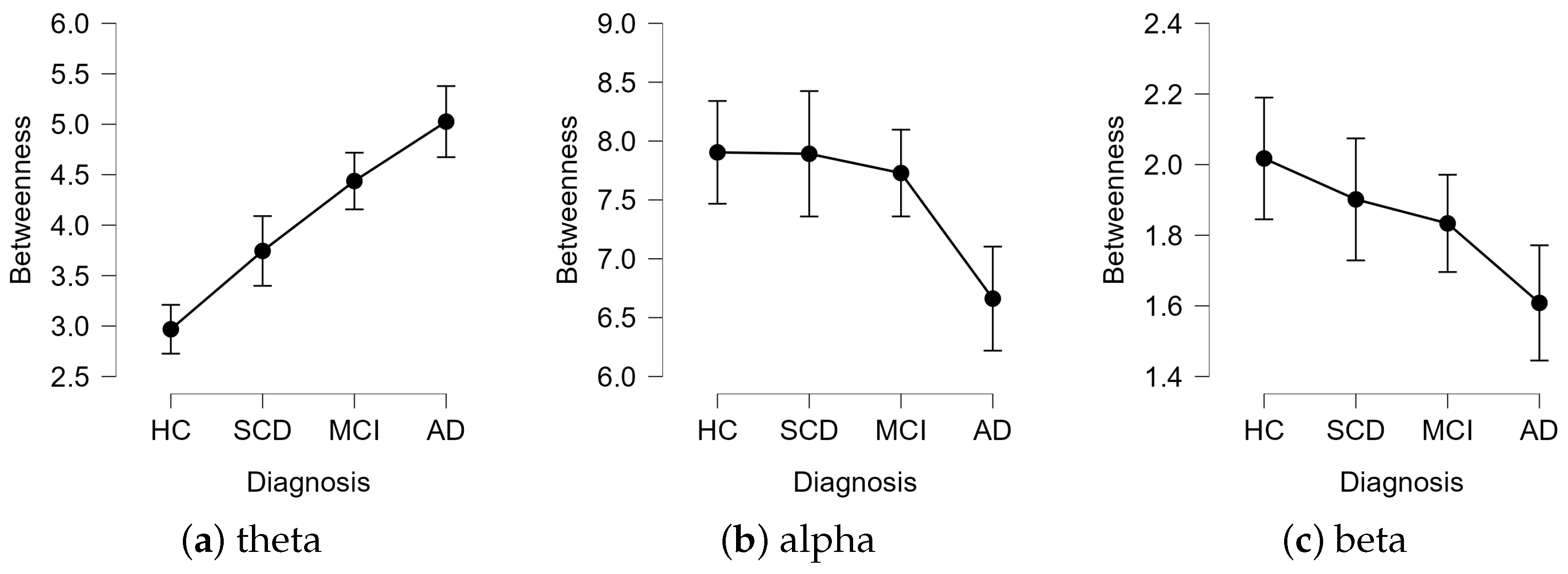
In addition to the above analysis of the theta band, we performed statistical analysis of the alpha and beta bands, the other two bands showing statistical significance, to support a holistic understanding of betweenness in the AD spectrum. In Table 3 and Table 4, we provide the ANCOVA results with respect to the alpha and beta bands. Furthermore, post hoc analysis of each band is provided in Table 5 and Table 6. We can see that AD showed statistically significant lower betweenness centrality in the alpha band with respect to all other groups, while in the beta band, AD showed statistically significant lower betweenness centrality with respect to the HC group. Overall, the results with respect to alpha and beta bands suggest a progressive decrease in betweenness centrality as one moves from HC to SCD, MCI, and then AD, with each stage of cognitive decline associated with a reduction in betweenness centrality when compared to more advanced disease’s stages, highlighting potential network disruption across the AD spectrum. Finally, in Figure 2, we provide descriptive plots with respect to all bands. This figure shows a significant trend across the AD spectrum, as follows: in low frequencies (theta), betweenness centrality increases with disease progression, whereas in higher frequencies, betweenness centrality decreases as the disease advances

3.2. Topographical Visualization

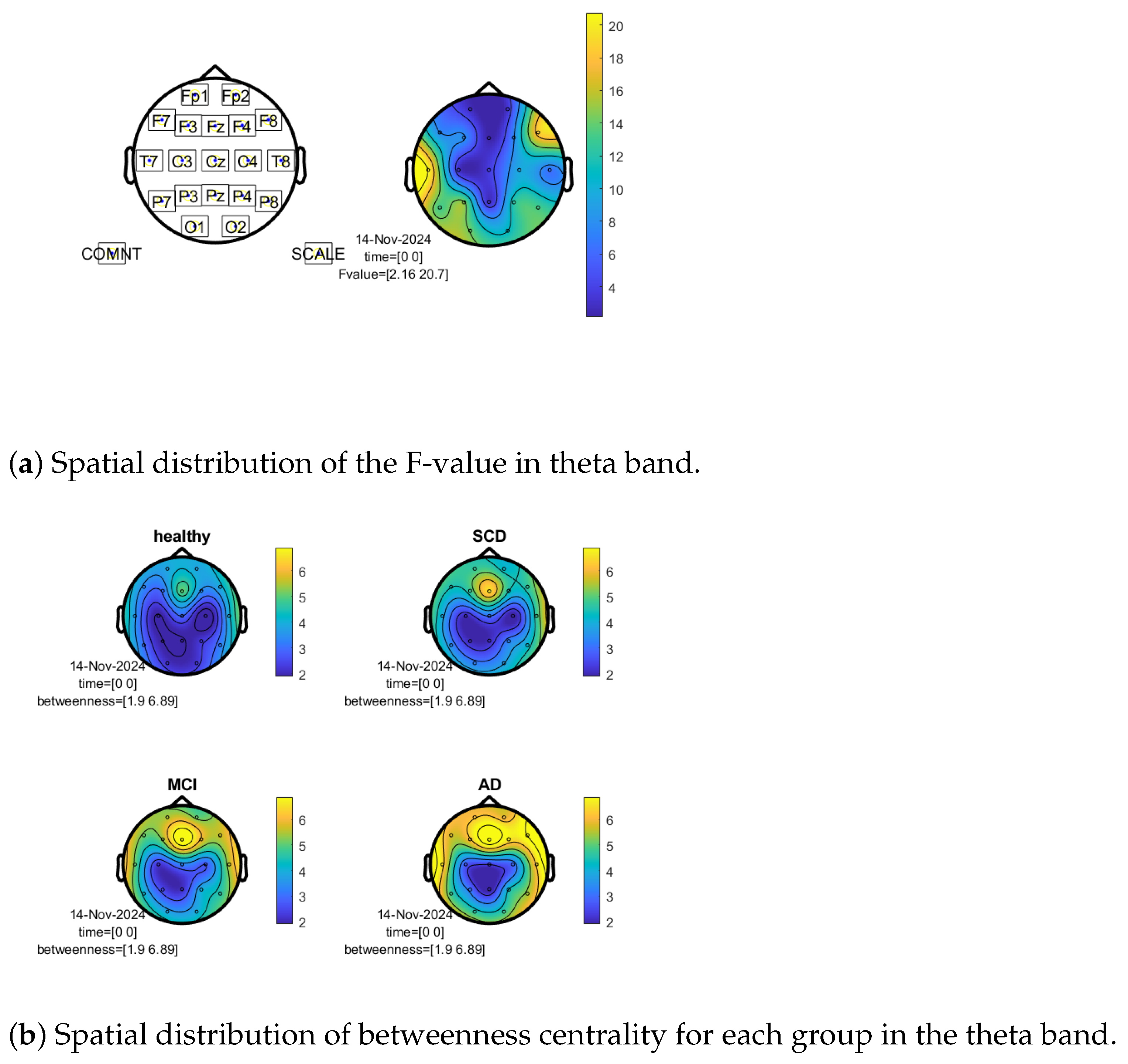
Figure 3a presents the spatial distribution of F-values obtained from ANCOVA for each EEG channel in the theta band, offering insights into the differences among the four groups across the scalp. Higher F-values indicate a greater degree of separation between groups in that specific channel, suggesting that the channel’s activity may reflect group differences more strongly. More specifically, Channels F8 and T7 show the highest F-values, indicating significant differences between groups in these regions. These channels, located in the right frontal and temporal areas, are often linked to cognitive functions such as executive control, memory, and auditory processing. A high F-value here suggests these areas may be particularly sensitive to changes across the AD spectrum, likely reflecting progressive neural degeneration or altered connectivity in these cognitive regions.
In Figure 3b, we provide the spatial maps of betweenness for each group. Betweenness centrality highlights nodes (or regions) that act as critical hubs within the network, so changes in these values across groups offer insights into how network integration and information flow are impacted by disease severity. Across the groups, we observe a progressive increase in betweenness values in the theta band for several channels as disease severity increases. Channels such as F8 and T7 show this trend distinctly, moving from HC to SCD, MCI, and finally, AD. The highest betweenness centrality values in the AD group suggest that as the disease progresses, certain channels become more central, potentially reflecting adaptations as the brain relies increasingly on these channels to maintain communication in the face of neural degradation. These results underscore the network reorganization that occurs in AD, where temporal and frontal regions (particularly T7 and F8) become increasingly critical in facilitating communication within the brain as the disease progresses.

3.3. Classification of AD Stages Based on Connectivity Metrics

Our goal, in this set of experiments, is to show the discriminative ability of connectivity metrics through a typical machine learning approach. In our study, all machine learning models have been implemented in Matlab. More specifically, we use an ensemble learning approach to build a robust classification model. Ensemble learning involves combining multiple weak models, such as decision trees, to create a stronger, more accurate classifier. By aggregating the predictions of multiple models, ensemble methods can reduce errors, increase stability, and handle noisy data more effectively than individual models. To ensure that all classes are treated equally during training, the method assigns uniform prior probabilities. This is especially valuable when dealing with imbalanced datasets, where some classes might have significantly fewer examples than others. By using uniform priors, the model is encouraged to treat all classes fairly, preventing it from being biased towards the more prevalent classes. To evaluate the performance and generalization ability of the ensemble model, cross-validation is employed, specifically using a 10-fold approach. Cross-validation helps provide a reliable estimate of the model’s accuracy on unseen data, mitigating the risk of overfitting and ensuring that the model is not simply memorizing the training data but is generalizing well. Finally, it is important to note that each sample in our dataset corresponds to a subject.
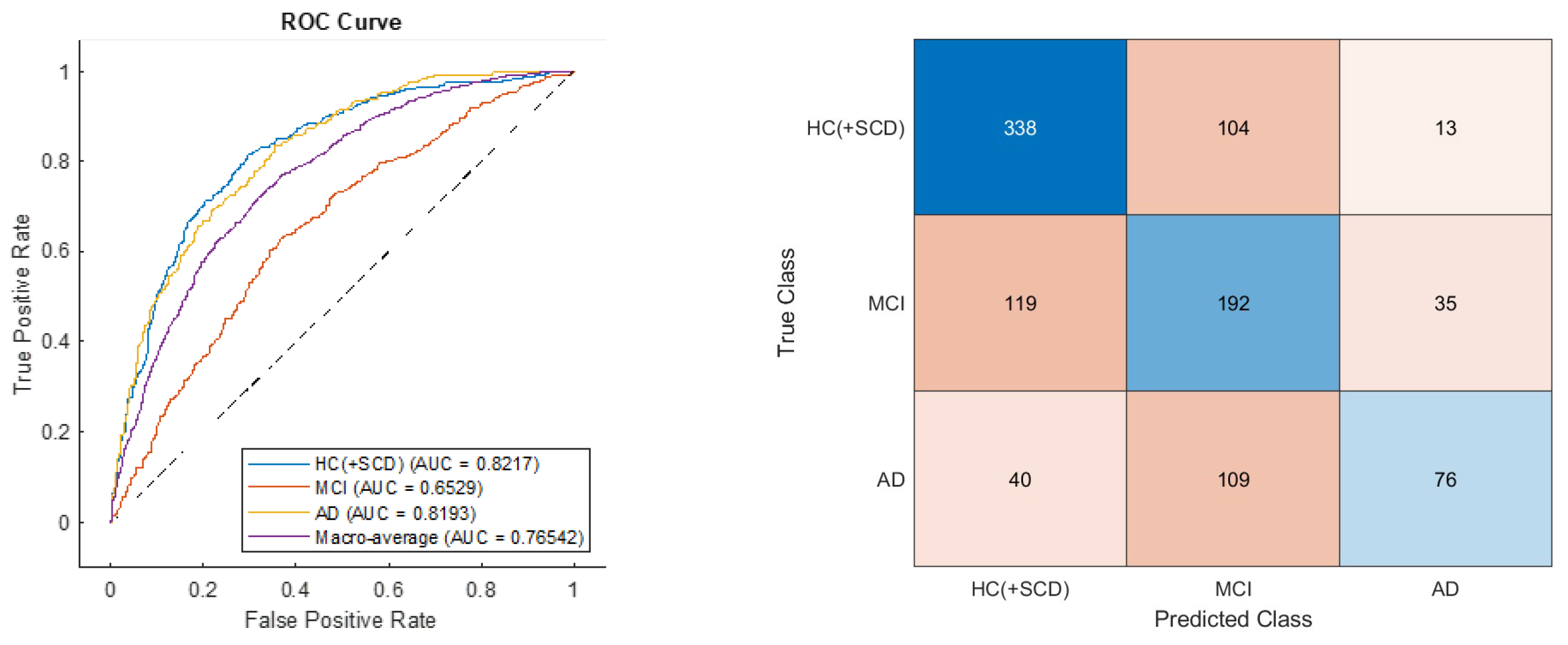
The first machine learning task is related to the discrimination between HC (including SCD), MCI, and AD. The goal of this task is to examine the discriminative ability of connectivity metrics in a widely used scenario and to provide a comparison with other models [27]. In Table 7, we provide the obtained metrics for our model. Additionally, we provide the metrics for various other models that have been used in the same dataset under the same experimental conditions [27]. Based on the performance metrics provided for different models (k-Nearest Neighbors (kNN), Support Vector Machine (SVM), Ieracitano-CNN, and Brain Connectivity), we can compare each model’s effectiveness in distinguishing between Healthy Controls (HC), Mild Cognitive Impairment (MCI), and Alzheimer’s Disease (AD) across precision, class-wise accuracy, sensitivity, and specificity. Brain Connectivity achieves the highest precision at 59.21%, suggesting it has the strongest ability to correctly classify samples across all groups. Ieracitano-CNN and SVM follow with moderate precision (54.27% and 52.33%, respectively), while kNN has the lowest precision at 36.80%, indicating that it may struggle more with misclassification. Overall, the Brain Connectivity model stands out as the top-performing method, showing the highest precision, accuracy, sensitivity, and specificity across most groups. This model’s success suggest that brain connectivity features are particularly informative in distinguishing between the stages of cognitive decline in Alzheimer’s disease. Additionally, in Figure 4, we provide the ROC curve, along with the confusion matrix, of our model in order to evaluate its overall performance with respect to each group. The classifier demonstrates strong performance for identifying Healthy Controls (HC) and Alzheimer’s Disease (AD), as reflected in the high AUC values for these groups. However, the AUC for MCI is lower, which suggests that the classifier has difficulty distinguishing MCI from other groups. This limitation may be due to the subtle and overlapping EEG features of MCI, which often make it challenging to distinguish this group from both healthy and AD groups.
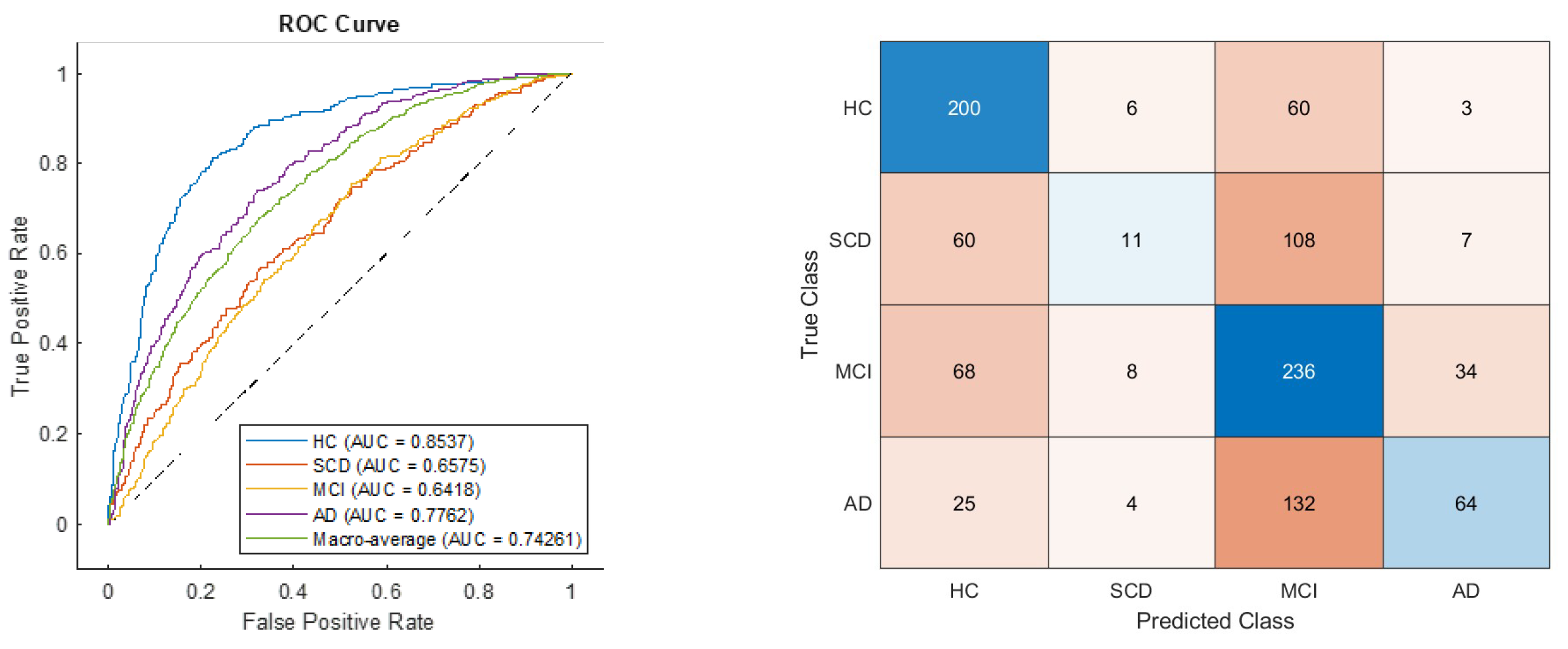
The second machine learning task is related to the discrimination of the four groups (HC, SCD, MCI, and AD), which is a much more difficult machine learning task not only to the inclusion of one more class but mostly due to properties of this class, since SCD presents similarities with HC and MCI and stands between these two groups. In Figure 5, we provide the ROC curves, along with the confusion matrix, for each group, as well as the macro-average ROC curve. The AUC values (HC: 0.85; SCD: 0.65; MCI: 0.64; and AD: 0.77) highlight the promising role of brain connectivity features in differentiating stages of cognitive decline across the AD spectrum. With an AUC of 0.85 for HC, connectivity features reliably capture the well-coordinated, stable network characteristic of healthy brain function, effectively distinguishing healthy individuals from those experiencing cognitive impairment. Furthermore, an AUC of 0.77 for AD demonstrates that connectivity metrics are sensitive to the significant disruptions in network organization associated with advanced AD, reflecting the classifier’s ability to identify AD-specific patterns such as reduced high-frequency connectivity and compensatory shifts to lower frequencies. The results for SCD and MCI (AUCs of 0.65 and 0.64) also highlight the subtle but detectable network shifts that connectivity features can capture even in early stages. Although these values are lower, they still indicate that connectivity features are picking up nuanced changes in network dynamics, which become more pronounced as the disease progresses. The macro-average AUC of 0.74 reflects an overall strong performance, showing that connectivity features can meaningfully differentiate between groups and provide a foundation for further refinement. With continued development, brain connectivity metrics hold significant potential for accurately identifying early cognitive changes and tracking progression across the AD spectrum.
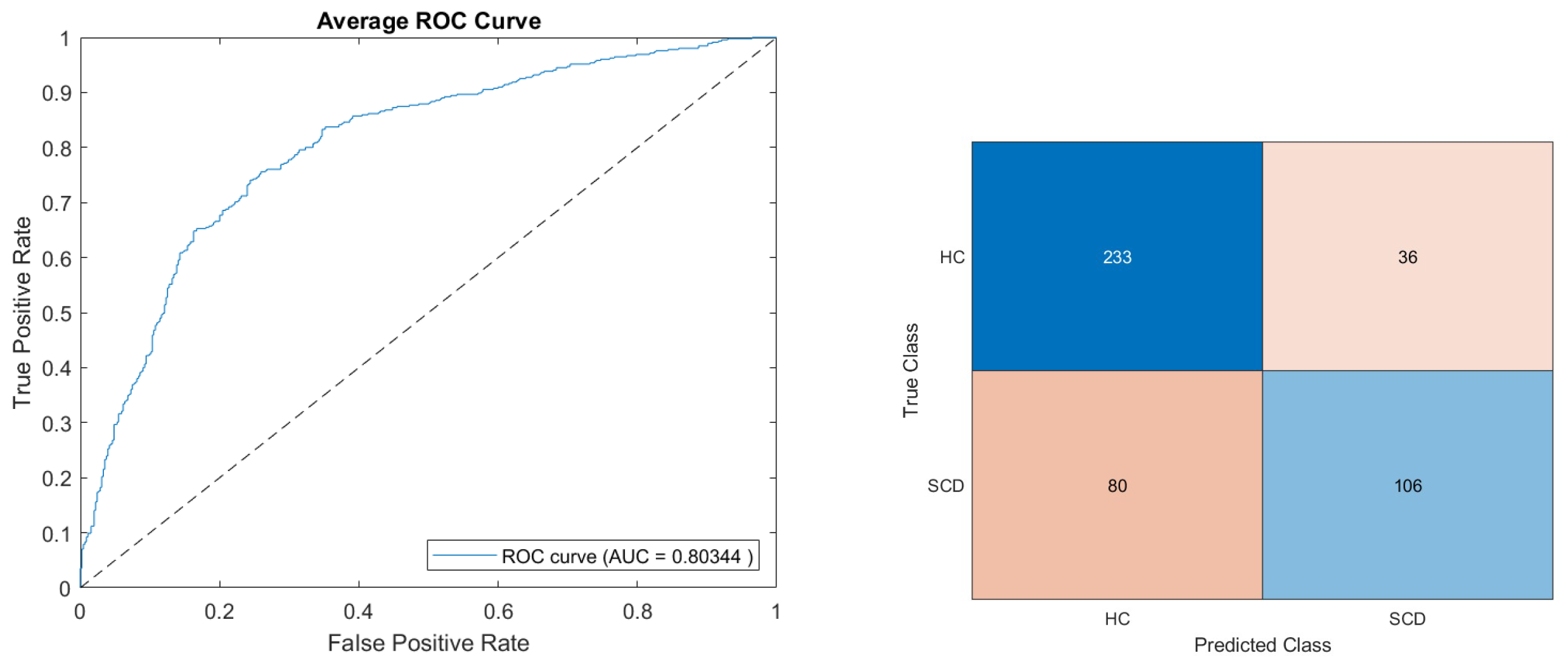
The third machine learning task is related to the discrimination of HC and SCD, a difficult task since the SCD group could not be discriminated from neurophysiological tests and its identification relies solely on the individual’s subjective experience of cognitive alterations, without definitive clinical or biological markers. We study this task because SCD is the first “step” in the AD spectrum, and our basic assumption here is that SCD individuals presents altered connectivity patterns related to HC. In Figure 6, we provide the ROC curve, along with the confusion matrix, for the binary classification task. The AUC of 0.80 reflects a strong performance, showing that connectivity features can meaningfully differentiate between HC and SCD, ultimately being able to identify participants at high risk of dementia and to give an indication of the likely disease trajectory. Nevertheless, the AUC of 0.80 leaves space for further improvement with respect to the identification of SCD. Overall, our analysis in this subsection shows that connectivity metrics could be used as potential biomarkers in AD spectrum.

4. Discussion

Many studies have shown that Alzheimer’s disease (AD) causes EEG signals to slow down as follows [8,20,35,36]: AD is associated with an increase of power in low frequencies (delta and theta band, 0.5–8 Hz) and a decrease of power in higher frequencies (alpha and beta, 8–30 Hz, and gamma, 30–100 Hz). The observed progressive increase in betweenness centrality within the theta band as AD severity worsens is consistent with the increase in theta power in AD because both indicate a shift towards using slower oscillatory networks to compensate for the loss of faster communication channels. This adaptation reflects the brain’s attempt to preserve connectivity despite the degeneration of higher-frequency networks, highlighting how the network reorganizes to maintain functions as the disease progresses. Additionally, the observed progressive decrease in betweenness centrality in the alpha and beta bands with increasing AD severity is consistent with the reduction in power in these bands. Both findings reflect a loss of efficient communication in high-frequency networks, which are crucial for supporting fast, localized information processing. As AD progresses, the degradation of these pathways leads to reduced network efficiency, contributing to cognitive decline.
Our experimental findings on betweenness centrality in the AD spectrum across different frequency bands provide insightful evidence that aligns well with the “Hub Overload and Failure” framework [17]. The increase in betweenness centrality in the theta band across the AD spectrum suggests that as neurodegeneration progresses, the brain increasingly relies on slower, long-range connections to maintain communication between regions. Theta-band activity is often associated with large-scale synchronization and compensatory mechanisms, especially in networks supporting memory and attention [37,38]. According to the “Hub Overload” phase of the framework, this increase in theta-band centrality likely reflects a compensatory reorganization, where the network adapts to the progressive loss of faster, localized connections by increasing connectivity in lower-frequency bands. As higher-frequency pathways weaken, theta-band hubs become more central to sustain communication across the network, taking on more “load” to preserve functionality. This shift toward slower oscillations may be an attempt of the brain to retain connectivity, but it also suggests growing reliance on a less efficient pathway, highlighting the network’s increased fragility. The decrease in betweenness centrality in the alpha and beta bands as AD severity increases indicates a loss of connectivity in these higher-frequency networks, which are typically involved in local, fast-paced communication. Beta activity, in particular, is often linked to cognitive tasks and motor control [39], while alpha band connectivity supports attention and sensory processing [40]. These bands are associated with efficient, localized communication. In the context of the “Hub Overload and Failure” framework, the observed decrease in higher-frequency betweenness reflects the “Hub Failure” phase. As AD advances, the brain’s high-frequency connectivity deteriorates, and hubs in these bands are no longer able to sustain their role as central nodes. This breakdown in fast-processing pathways contributes to network fragmentation, as the ability to support quick, local integration is lost. Essentially, these high-frequency hubs are failing under the burden of neurodegeneration, signaling the brain’s diminishing capacity to sustain normal processing speeds and integration across these bands.
Overall, the shift from high-frequency (alpha and beta) centrality to low-frequency (theta) centrality is consistent with findings that, as the brain undergoes structural and functional decline in AD, it becomes increasingly dependent on slower-frequency bands [35]. This pattern indicates a fundamental reorganization in network strategy, where the brain compensates for failing fast-communication pathways by using slower oscillations, while this adaptation supports connectivity to some degree, and it comes with limitations in processing efficiency and speed [17]. This trend also highlights a growing vulnerability; as the brain centralizes communication around a few theta-band hubs, it becomes more susceptible to further disruptions. The reliance on theta hubs represents fragile network adaptation, and if these hubs begin to fail, the network may undergo accelerated fragmentation, potentially correlating with rapid cognitive decline in the later stages of AD.
Graph analysis is a popular approach to study brain networks in neurodegenerative disorders such as Alzheimer’s disease (AD). However, the reported results across similar studies are often not consistent, and there is not a general consensus about the behavior of a metric related to the severity of the disease. For example, with respect to the clustering coefficient, some studies have reported increases in the clustering coefficient [21,41], while others have reported a decrease [42,43,44]. Similar conclusions can be drawn for the betweenness centrality, since in Refs. [45,46], a decrease with respect to disease severity is reported, while Ref. [47] reports an increase. This variability regarding connectivity metrics in the AD spectrum can be attributed to several factors, reflecting both biological and methodological differences. On the biological side, differences in the underlying network substrates—such as white matter fiber tract networks, cortical thickness networks, or resting-state functional networks—can lead to variability in observed connectivity patterns across studies. However, part of the inconsistency also stems from differences in how these networks are created and analyzed. Graph theoretic analysis is widely used to study connectivity across the AD spectrum, but the results can be sensitive to the methods used for network construction [44,45,48,49]. For instance, there is often a thresholding problem in defining graph networks from EEG data, where the choice of thresholds significantly influences the resulting connectivity metrics [31]. Additionally, variability in findings can arise from the use of different measures to define connectivity, such as correlation, coherence, or the phase locking value. These measures capture different aspects of synchronization between brain regions, leading to potential discrepancies in network properties. Furthermore, variability also arises from differences in how EEG signals are preprocessed, including manual artifact removal, which can introduce bias [8]. Differences in patient populations across studies also contribute to this variability [1,48], as the AD spectrum includes conditions ranging from subjective cognitive decline (SCD) to mild cognitive impairment (MCI) and advanced AD. The progression of neurodegeneration is highly individualized [1], leading to variations in how brain networks reorganize in response to disease progression. This heterogeneity, combined with differences in EEG recording protocols, electrode configurations, and the analysis of specific frequency bands (such as delta, theta, alpha, and beta), makes it challenging to compare results across studies. Furthermore, in most studies, only a few graph metrics are reported in common, undermining the examination of similarities across studies and precluding meta-analyses [28,44]. Additionally, many AD patients also suffer from other health conditions or take medications that can influence brain connectivity [50]. These factors introduce variability in brain imaging data (i.e., EEG or fMRI time-series), particularly in studies where such variables are not fully controlled or accounted for.
The sensitivity of correlation and PLV metrics to noise is closely related to the challenges inherent in the linear inverse EEG problem [51], which aims to estimate the neural sources generating the observed scalp EEG signals. EEG recordings are affected by volume conduction and signal mixing, leading to the spread of activity across multiple electrodes, which can artificially inflate connectivity measures. Correlation-based connectivity is particularly vulnerable to this issue, as shared noise or common reference effects can introduce spurious connections in brain network graphs. Similarly, PLV, which captures phase synchronization, may be distorted by noise-related phase fluctuations, further complicating the accurate reconstruction of functional interactions. While source-space EEG connectivity analysis is often used to mitigate these effects [21,52], it typically requires more than 32 EEG channels for accurate source localization. In our case, with only 19 EEG channels, performing such an analysis is not feasible with conventional methods. However, we recognize the importance of addressing this limitation and intend to develop carefully crafted inverse EEG algorithms that take into account the constraints of low-density EEG recordings. These future approaches will aim to enhance source reconstruction accuracy and improve the reliability of functional connectivity estimates, reducing the impact of noise and volume conduction in brain network analysis.

5. Conclusions

This study focuses on leveraging EEG-based functional connectivity metrics to investigate brain network alterations across the AD spectrum. By employing graph theory metrics such as betweenness centrality, the clustering coefficient, and global efficiency, we found significant connectivity changes across EEG frequency bands. The findings demonstrate a progressive increase in theta-band connectivity metrics and a decrease in alpha and beta-band metrics as the disease advances, reflecting the neural network reorganization associated with AD. These results show the potential of EEG-derived connectivity features as powerful, cost-effective biomarkers for differentiating stages of AD and monitoring disease progression, bridging the gap between computational neuroscience and clinical applications.
Future work could focus on cross-dataset and cross-session evaluations to validate the generalizability of the proposed methods. Cross-dataset analysis will provide insights related to the robustness of connectivity across various experimental setups, while cross-session analysis will evaluate connectivity from the same subjects at different times. These approaches will enhance the adaptability of the models for real-world applications in Alzheimer’s disease diagnosis and monitoring. Additionally, the analysis of connectivity in the AD spectrum could focus on integrating advanced techniques like Riemannian deep learning models, graph signal processing, and sparse representation classification (SRC) with graph-based priors under a Bayesian framework. Riemannian deep learning leverages the non-Euclidean structure of EEG data to capture intricate patterns in brain dynamics, while graph signal processing can analyze brain networks as signals on graphs, identifying subtle disruptions in connectivity across the AD spectrum. Incorporating graph-based priors into SRC under a Bayesian framework can enhance feature selection by leveraging prior knowledge of brain network structures, leading to more robust classification models. This approach could significantly improve the early detection and monitoring of AD.

Author Contributions

Conceptualization, V.P.O., K.G., I.L., S.N., I.K., and PREDICTOM Consortium; methodology, V.P.O., K.G., I.L., and S.N.; writing—original draft preparation, V.P.O.; writing—review and editing, V.P.O., K.G., I.L., and S.N.; supervision, I.K.; project administration, PREDICTOM Consortium. All authors have read and agreed to the published version of the manuscript.

Funding

This research was funded by the Innovative Health Initiative Joint Undertaking (IHI JU), under Grant Agreement No. 101132356.

Institutional Review Board Statement

This study is a secondary analysis of the publicly available EEG dataset: CAUEGG, which is provided in de-identified/anonymized form. No new data were collected from human participants and no participant re-contact or intervention was performed. Therefore, ethical review and approval were not required for this study.

Informed Consent Statement

This study used only publicly available, de-identified/anonymized EEG data from CAUEEG dataset. Therefore, informed consent was not required for this secondary analysis.

Data Availability Statement

The original data presented in the study are openly available in Github at https://github.com/ipis-mjkim/caueeg-dataset?tab=readme-ov-file, accessed on 26 February 2024.

Acknowledgments

The authors would like to extend their gratitude to the authors of [27] for providing the CAUEGG dataset. Additionally, PREDICTOM is supported by the Innovative Health Initiative Joint Undertaking (IHI JU), under Grant Agreement No. 101132356. JU receives support from the European Union’s Horizon Europe research and innovation programme, COCIR, EFPIA, EuropaBio, MedTechEurope and Vaccines Europe. The UK participants are supported by UKRI Grant No. 10083467 (National Institute for Health and Care Excellence), Grant No. 10083181 (King’s College London), and Grant No. 10091560 (University of Exeter). The University of Geneva is supported by the Swiss State Secretariat for Education, Research and Innovation Ref. No. 113152304. See www.ihi.europa.eu for more details, accessed on 22 January 2024 PREDICTOM Consortium: We thank all past and present PREDICTOM consortium members for their contribution to the project (in alphabetical order): Aarsland, Dag; Alepopoulos, Vasilis; Álvarez-Sánchez, Lourdes; Ashton, Nick; Bagoly, Andrea; Ballard, Clive; Banerjee, Suchandrima; Barros, Nuno; Baur, Andreas; Baquero, Miguel; Beaume, Nicolas; Berkley, Nathan; Beser Robles, María; Birk, Cindy; Blasco, Ana Penadés; Bloomfield, Adam; Botz, Jonas; Bradshaw, Angela; Brem, Anna-Katharine; Brandt, Sigurd; Brogaard, Niels Juul; Cacciamani, Federica; Campill, Sarah; Cerdá Alberich, Leonor; Cháfer-Pericás, Consuelo; Corbett, Anne; Costa, Alex Ignatius; Csizmadia, Annamária; Cresswell, Katharine; Dawoud, Dalia; De Witte, Sara; Diaz, Ana; Diranzo Año, Rita Belen; Durrleman, Stanley; Engelborghs, Sebastiaan; Ferenczi, Lehel; Fernandez, Brice; Ferré-González, Laura; Filkor, Kata; Frisoni, Giovanni; Fröhlich, Holger; Frontó, András; Georges, Jean; Georgiadis, Kostas; Giannios, Giorgos; Gjestsen, Martha; Gove, Dianne; Grammatikopoulou, Margarita; Gupta, Ankit; Guru Rao, Sathvik; Hudak, Anett; Huang, Bin; Huynh, Duong; Hjelle, Anne; Ignatius Costa, Alex; Jacot, Yann; Jeromin, Andreas; Johannsen, Peter; Kleinstuber, Kelly; Knauer, Johannes; Kallevag, Øystein; Kaushik, Sandeep; Khan, Zunera; Kim, Ha Young; Kollmer, Stephan; Kompatsiaris Ioannis, Koot, Wim-Jan; Koval, Igor; Kodamullil, Alpha; Ladic, Lance; Layton, Richard; Lazarou Ioulietta, Leon Colombo, Teresa; Letoha, Tamas; Lewis, Jack; Lewis, Steve; Lim, Katrine; Licence, Sam; Martí Bonmatí, Luis; Marquardt, Gaby; Mátételki, Péter; Mendes, Augusto J.; Mitterreiter, Johanna; Moro, Christian; Mosbacher, Jochen A.; Müllenborn, Matthias; Niessen, Natascha; Nikolopoulos, Spiros; Noeske, Ralph; Oikonomou, Vangelis; Orgel, Thomas; Osland, Audun; Paletta, Palmer, Abbie; Lucas; Pap, Antal; Peña-Bautista, Carmen; Perneczky, Patterson, Mary; Robert; Philipp, Isabelle; Pickering, Ellie; Pooley, Wez; Praet, Jelle; Pszeida, Martin; Rauchmann, Boris-Stephan; Ribaldi, Federica; Ribbens, Annemie; Richards, Megan; Russegger, Silvia; Salih, Fatima; Scheiber, Barbara; Schmalz, Andreas; Schneeberger, Michael; Shadmaan, Amied; Schirmer, Timo; Shinkins, Bethany; Smart, Lesleyann; Solana, Ana Beatriz; Spector, Joshua; Sunde, Anita Lenora; Tarnanas, Ioannis; Testad, Ingelin; Timko, Edina; Trydal, Espen Knut; Van Deun, Jan; van der Giezen, Mark; Verheij, Herman; Verjans, Robin; Weiss, Wolfgang; Yang, Hongxu; Beaume, Nicolas.

Conflicts of Interest

The authors declare no conflicts of interest. The funders had no role in the design of the study; in the collection, analyses, or interpretation of data; in the writing of the manuscript; or in the decision to publish the results.

Correction Statement

This article has been republished with a minor correction to the Institutional Review Board Statement and Informed Consent Statement. This change does not affect the scientific content of the article.

References

  1. Jack, C.R.; Bennett, D.A.; Blennow, K.; Carrillo, M.C.; Dunn, B.; Haeberlein, S.B.; Holtzman, D.M.; Jagust, W.; Jessen, F.; Karlawish, J.; et al. NIA-AA Research Framework: Toward a biological definition of Alzheimer’s disease. Alzheimer’s Dement. 2018, 14, 535–562. [Google Scholar] [CrossRef] [PubMed]
  2. Alberdi, A.; Aztiria, A.; Basarab, A. On the early diagnosis of Alzheimer’s Disease from multimodal signals: A survey. Artif. Intell. Med. 2016, 71, 1–29. [Google Scholar] [CrossRef] [PubMed]
  3. Kim, S.K.; Kim, H.; Kim, S.H.; Kim, J.B.; Kim, L. Electroencephalography-based classification of Alzheimer’s disease spectrum during computer-based cognitive testing. Sci. Rep. 2024, 14, 5252. [Google Scholar] [CrossRef]
  4. Jessen, F.; Amariglio, R.E.; Van Boxtel, M.; Breteler, M.; Ceccaldi, M.; Chételat, G.; Dubois, B.; Dufouil, C.; Ellis, K.A.; Van Der Flier, W.M.; et al. A conceptual framework for research on subjective cognitive decline in preclinical Alzheimer’s disease. Alzheimer’s Dement. 2014, 10, 844–852. [Google Scholar] [CrossRef]
  5. Sperling, R.; Mormino, E.; Johnson, K. The Evolution of Preclinical Alzheimer’s Disease: Implications for Prevention Trials. Neuron 2014, 84, 608–622. [Google Scholar] [CrossRef]
  6. Jessen, F.; Amariglio, R.E.; Buckley, R.F.; Van Der Flier, W.M.; Han, Y.; Molinuevo, J.L.; Rabin, L.; Rentz, D.M.; Rodriguez-Gomez, O.; Saykin, A.J.; et al. The characterisation of subjective cognitive decline. Lancet Neurol. 2020, 19, 271–278. [Google Scholar] [CrossRef] [PubMed]
  7. Si, T.; Xing, G.; Han, Y. Subjective Cognitive Decline and Related Cognitive Deficits. Front. Neurol. 2020, 11, 247. [Google Scholar] [CrossRef]
  8. Cassani, R.; Estarellas, M.; San-Martin, R.; Fraga, F.J.; Falk, T.H. Systematic Review on Resting-State EEG for Alzheimer’s Disease Diagnosis and Progression Assessment. Dis. Markers 2018, 2018, 5174815. [Google Scholar] [CrossRef]
  9. Zheng, X.; Wang, B.; Liu, H.; Wu, W.; Sun, J.; Fang, W.; Jiang, R.; Hu, Y.; Jin, C.; Wei, X.; et al. Diagnosis of Alzheimer’s disease via resting-state EEG: Integration of spectrum, complexity, and synchronization signal features. Front. Aging Neurosci. 2023, 15, 1288295. [Google Scholar] [CrossRef]
  10. Sharma, N.; Kolekar, M.; Jha, K.; Kumar, Y. EEG and Cognitive Biomarkers Based Mild Cognitive Impairment Diagnosis. IRBM 2019, 40, 113–121. [Google Scholar] [CrossRef]
  11. Abazid, M.; Houmani, N.; Boudy, J.; Dorizzi, B.; Mariani, J.; Kinugawa, K. A Comparative Study of Functional Connectivity Measures for Brain Network Analysis in the Context of AD Detection with EEG. Entropy 2021, 23, 1553. [Google Scholar] [CrossRef] [PubMed]
  12. Şeker, M.; Özbek, Y.; Yener, G.; Özerdem, M.S. Complexity of EEG Dynamics for Early Diagnosis of Alzheimer’s Disease Using Permutation Entropy Neuromarker. Comput. Methods Programs Biomed. 2021, 206, 106116. [Google Scholar] [CrossRef] [PubMed]
  13. Su, R.; Li, X.; Li, Z.; Han, Y.; Cui, W.; Xie, P.; Liu, Y. Constructing biomarker for early diagnosis of aMCI based on combination of multiscale fuzzy entropy and functional brain connectivity. Biomed. Signal Process. Control 2021, 70, 103000. [Google Scholar] [CrossRef]
  14. Stam, C.J. Modern network science of neurological disorders. Nat. Rev. Neurosci. 2014, 15, 683–695. [Google Scholar] [CrossRef]
  15. Vecchio, F.; Miraglia, F.; Maria Rossini, P. Connectome: Graph theory application in functional brain network architecture. Clin. Neurophysiol. Pract. 2017, 2, 206–213. [Google Scholar] [CrossRef] [PubMed]
  16. Friston, K.J. Functional and Effective Connectivity: A Review. Brain Connect. 2011, 1, 13–36. [Google Scholar] [CrossRef]
  17. Stam, C.J. Hub overload and failure as a final common pathway in neurological brain network disorders. Netw. Neurosci. 2024, 8, 1–23. [Google Scholar] [CrossRef]
  18. Rubinov, M.; Sporns, O. Complex network measures of brain connectivity: Uses and interpretations. NeuroImage 2010, 52, 1059–1069. [Google Scholar] [CrossRef]
  19. Vecchio, F.; Miraglia, F.; Quaranta, D.; Granata, G.; Romanello, R.; Marra, C.; Bramanti, P.; Rossini, P. Cortical connectivity and memory performance in cognitive decline: A study via graph theory from EEG data. Neuroscience 2016, 316, 143–150. [Google Scholar] [CrossRef]
  20. Chetty, C.A.; Bhardwaj, H.; Kumar, G.P.; Devanand, T.; Sekhar, C.S.A.; Aktürk, T.; Kiyi, I.; Yener, G.; Güntekin, B.; Joseph, J.; et al. EEG biomarkers in Alzheimer’s and prodromal Alzheimer’s: A comprehensive analysis of spectral and connectivity features. Alzheimer’s Res. Ther. 2024, 16, 236. [Google Scholar] [CrossRef]
  21. Vecchio, F.; Miraglia, F.; Marra, C.; Quaranta, D.; Vita, M.G.; Bramanti, P.; Rossini, P.M. Human Brain Networks in Cognitive Decline: A Graph Theoretical Analysis of Cortical Connectivity from EEG Data. J. Alzheimer’s Dis. 2014, 41, 113–127. [Google Scholar] [CrossRef] [PubMed]
  22. Miraglia, F.; Vecchio, F.; Bramanti, P.; Rossini, P.M. EEG characteristics in “eyes-open” versus “eyes-closed” conditions: Small-world network architecture in healthy aging and age-related brain degeneration. Clin. Neurophysiol. 2016, 127, 1261–1268. [Google Scholar] [CrossRef]
  23. Fodor, Z.; Horváth, A.; Hidasi, Z.; Gouw, A.A.; Stam, C.J.; Csukly, G. EEG Alpha and Beta Band Functional Connectivity and Network Structure Mark Hub Overload in Mild Cognitive Impairment During Memory Maintenance. Front. Aging Neurosci. 2021, 13, 680200. [Google Scholar] [CrossRef] [PubMed]
  24. Cai, L.; Wei, X.; Liu, J.; Zhu, L.; Wang, J.; Deng, B.; Yu, H.; Wang, R. Functional Integration and Segregation in Multiplex Brain Networks for Alzheimer’s Disease. Front. Neurosci. 2020, 14, 51. [Google Scholar] [CrossRef]
  25. Das, S.; Puthankattil, S.D. Complex network analysis of MCI-AD EEG signals under cognitive and resting state. Brain Res. 2020, 1735, 146743. [Google Scholar] [CrossRef] [PubMed]
  26. Wang, J.; Zhao, J.; Chen, X.; Yin, B.; Li, X.; Xie, P. Alzheimer’s disease diagnosis using rhythmic power changes and phase differences: A low-density EEG study. Front. Aging Neurosci. 2025, 16, 1485132. [Google Scholar] [CrossRef]
  27. Kim, M.J.; Youn, Y.C.; Paik, J. Deep learning-based EEG analysis to classify normal, mild cognitive impairment, and dementia: Algorithms and dataset. NeuroImage 2023, 272, 120054. [Google Scholar] [CrossRef] [PubMed]
  28. Hallquist, M.N.; Hillary, F.G. Graph theory approaches to functional network organization in brain disorders: A critique for a brave new small-world. Netw. Neurosci. 2019, 3, 1–26. [Google Scholar] [CrossRef]
  29. Tang, H.; Ma, G.; Zhang, Y.; Ye, K.; Guo, L.; Liu, G.; Huang, Q.; Wang, Y.; Ajilore, O.; Leow, A.D.; et al. A comprehensive survey of complex brain network representation. Meta-Radiology 2023, 1, 100046. [Google Scholar] [CrossRef]
  30. Farahani, F.V.; Karwowski, W.; Lighthall, N.R. Application of Graph Theory for Identifying Connectivity Patterns in Human Brain Networks: A Systematic Review. Front. Neurosci. 2019, 13, 585. [Google Scholar] [CrossRef]
  31. Adamovich, T.; Zakharov, I.; Tabueva, A.; Malykh, S. The thresholding problem and variability in the EEG graph network parameters. Sci. Rep. 2022, 12, 18659. [Google Scholar] [CrossRef]
  32. Sporns, O. Graph theory methods: Applications in brain networks. Dialogues Clin. Neurosci. 2018, 20, 111–121. [Google Scholar] [CrossRef] [PubMed]
  33. Joyce, K.E.; Laurienti, P.J.; Burdette, J.H.; Hayasaka, S. A New Measure of Centrality for Brain Networks. PLoS ONE 2010, 5, e12200. [Google Scholar] [CrossRef] [PubMed]
  34. Blum, S.; Jacobsen, N.S.J.; Bleichner, M.G.; Debener, S. A Riemannian Modification of Artifact Subspace Reconstruction for EEG Artifact Handling. Front. Hum. Neurosci. 2019, 13, 141. [Google Scholar] [CrossRef] [PubMed]
  35. Dauwels, J.; Vialatte, F.B.; Cichocki, A. On the Early Diagnosis of Alzheimer’s Disease from EEG Signals: A Mini-Review. In Advances in Cognitive Neurodynamics (II); Wang, R., Gu, F., Eds.; Springer: Dordrecht, The Netherlands, 2011; pp. 709–716. [Google Scholar] [CrossRef]
  36. Yang, X.; Fan, Z.; Li, Z.; Zhou, J. Resting-state EEG microstate features for Alzheimer’s disease classification. PLoS ONE 2024, 19, e0311958. [Google Scholar] [CrossRef]
  37. Tan, E.; Troller-Renfree, S.V.; Morales, S.; Buzzell, G.A.; McSweeney, M.; Antúnez, M.; Fox, N.A. Theta activity and cognitive functioning: Integrating evidence from resting-state and task-related developmental electroencephalography (EEG) research. Dev. Cogn. Neurosci. 2024, 67, 101404. [Google Scholar] [CrossRef]
  38. Oikonomou, V.P.; Geordiadis, K.; Kalaganis, F.P.; Nikolopoulos, S.; Kompatsiaris, I. Prediction of Successful Memory Formation during Audiovisual advertising using EEG signals. In Proceedings of the 2024 IEEE Conference on Artificial Intelligence (CAI), Singapore, 25–27 June 2024; pp. 1111–1116. [Google Scholar] [CrossRef]
  39. Weiss, S.; Mueller, H.M. “Too Many betas do not Spoil the Broth”: The Role of Beta Brain Oscillations in Language Processing. Front. Psychol. 2012, 3, 201. [Google Scholar] [CrossRef]
  40. Foxe, J.J.; Snyder, A.C. The Role of Alpha-Band Brain Oscillations as a Sensory Suppression Mechanism during Selective Attention. Front. Psychol. 2011, 2, 154. [Google Scholar] [CrossRef] [PubMed]
  41. Hallett, M.; De Haan, W.; Deco, G.; Dengler, R.; Di Iorio, R.; Gallea, C.; Gerloff, C.; Grefkes, C.; Helmich, R.C.; Kringelbach, M.L.; et al. Human brain connectivity: Clinical applications for clinical neurophysiology. Clin. Neurophysiol. 2020, 131, 1621–1651. [Google Scholar] [CrossRef]
  42. Sun, Y.; Yin, Q.; Fang, R.; Yan, X.; Wang, Y.; Bezerianos, A.; Tang, H.; Miao, F.; Sun, J. Disrupted Functional Brain Connectivity and Its Association to Structural Connectivity in Amnestic Mild Cognitive Impairment and Alzheimer’s Disease. PLoS ONE 2014, 9, e96505. [Google Scholar] [CrossRef]
  43. Lazarou, I.; Georgiadis, K.; Nikolopoulos, S.; Oikonomou, V.P.; Tsolaki, A.; Kompatsiaris, I.; Tsolaki, M.; Kugiumtzis, D. A Novel Connectome-based Electrophysiological Study of Subjective Cognitive Decline Related to Alzheimer’s Disease by Using Resting-state High-density EEG EGI GES 300. Brain Sci. 2020, 10, 392. [Google Scholar] [CrossRef]
  44. Phillips, D.J.; McGlaughlin, A.; Ruth, D.; Jager, L.R.; Soldan, A. Graph theoretic analysis of structural connectivity across the spectrum of Alzheimer’s disease: The importance of graph creation methods. Neuroimage Clin. 2015, 7, 377–390. [Google Scholar] [CrossRef] [PubMed]
  45. Frantzidis, C.A.; Vivas, A.B.; Tsolaki, A.; Klados, M.A.; Tsolaki, M.; Bamidis, P.D. Functional disorganization of small-world brain networks in mild Alzheimer’s Disease and amnestic Mild Cognitive Impairment: An EEG study using Relative Wavelet Entropy (RWE). Front. Aging Neurosci. 2014, 6, 224. [Google Scholar] [CrossRef]
  46. RADAR-AD Consortium; Lazarou, I.; Georgiadis, K.; Nikolopoulos, S.; Oikonomou, V.P.; Stavropoulos, T.G.; Tsolaki, A.; Kompatsiaris, I.; Tsolaki, M. Exploring Network Properties Across Preclinical Stages of Alzheimer’s Disease Using a Visual Short-Term Memory and Attention Task with High-Density Electroencephalography: A Brain-Connectome Neurophysiological Study. J. Alzheimer’s Dis. 2022, 87, 643–664. [Google Scholar] [CrossRef]
  47. Engels, M.M.; Stam, C.J.; Van Der Flier, W.M.; Scheltens, P.; De Waal, H.; Van Straaten, E.C. Declining functional connectivity and changing hub locations in Alzheimer’s disease: An EEG study. BMC Neurol. 2015, 15, 145. [Google Scholar] [CrossRef] [PubMed]
  48. Scheijbeler, E.P.; De Haan, W.; Stam, C.J.; Twisk, J.W.R.; Gouw, A.A. Longitudinal resting-state EEG in amyloid-positive patients along the Alzheimer’s disease continuum: Considerations for clinical trials. Alzheimer’s Res. Ther. 2023, 15, 182. [Google Scholar] [CrossRef] [PubMed]
  49. Mårtensson, G.; Pereira, J.B.; Mecocci, P.; Vellas, B.; Tsolaki, M.; Kłoszewska, I.; Soininen, H.; Lovestone, S.; Simmons, A.; Volpe, G.; et al. Stability of graph theoretical measures in structural brain networks in Alzheimer’s disease. Sci. Rep. 2018, 8, 11592. [Google Scholar] [CrossRef]
  50. Santiago, J.A.; Potashkin, J.A. The Impact of Disease Comorbidities in Alzheimer’s Disease. Front. Aging Neurosci. 2021, 13, 631770. [Google Scholar] [CrossRef]
  51. Oikonomou, V.P.; Kompatsiaris, I. A Novel Bayesian Approach for EEG Source Localization. Comput. Intell. Neurosci. 2020, 2020, 8837954. [Google Scholar] [CrossRef]
  52. Aoki, Y.; Takahashi, R.; Suzuki, Y.; Pascual-Marqui, R.D.; Kito, Y.; Hikida, S.; Maruyama, K.; Hata, M.; Ishii, R.; Iwase, M.; et al. EEG resting-state networks in Alzheimer’s disease associated with clinical symptoms. Sci. Rep. 2023, 13, 3964. [Google Scholar] [CrossRef]
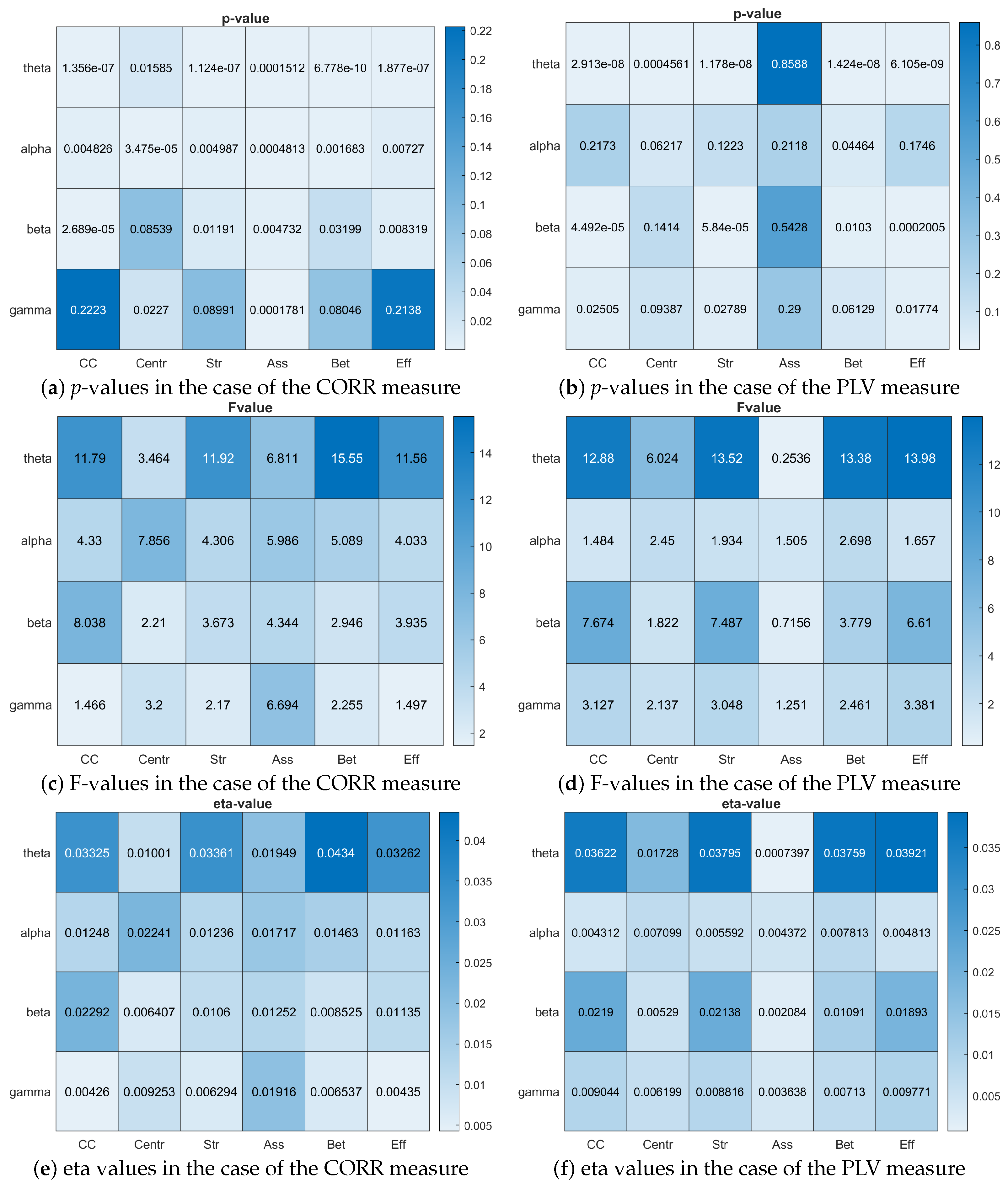
Figure 1. ANCOVA collective results over brain rhythms, connectivity metrics, and connectivity measures. Each cell of the above matrices represents the statistic (p-value, F-value, or eta value) from the corresponding ANCOVA test.
Jdad 02 00012 g001
Figure 2. Descriptive plots illustrating the betweenness centrality trends across groups and bands.
Jdad 02 00012 g002
Figure 3. Spatial distributions of statistics and betweenness centrality in the theta band.
Jdad 02 00012 g003
Figure 4. ROC curves and the confusion matrix for the second machine learning task, which is related to the discrimination between HC, SCD, MCI, and AD.
Jdad 02 00012 g004
Figure 5. ROC curves and the confusion matrix for the first machine learning task, which is related to the discrimination between HC (including SCD), MCI, and AD.
Jdad 02 00012 g005
Figure 6. ROC curves and the confusion matrix for the third machine learning task, which is related to the discrimination between HC, SCD, MCI, and AD.
Jdad 02 00012 g006
Table 1. ANCOVA results for betweenness centrality in the theta band across the AD Spectrum.
CasesSum of SquaresdfMean SquareFp η 2
Diagnosis281.320393.77315.547<0.0010.043
Age70.211170.21111.641<0.0010.011
Residuals6200.49310286.032
Note: Type III sum of squares.
Table 2. Post hoc analysis of group differences in betweenness centrality in the theta band.
Mean DifferenceSEt p tukey
HCSCD−0.5400.244−2.2150.120
MCI−1.1240.223−5.032<0.001 ***
AD−1.6360.253−6.474<0.001 ***
SCDMCI−0.5840.226−2.5870.048 *
AD−1.0960.248−4.410<0.001 ***
MCIAD−0.5120.210−2.4330.072
* p < 0.05, *** p < 0.001. Note: p-value adjusted for comparing a family of 4.
Table 3. ANCOVA results for betweenness centrality in the alpha band across the AD Spectrum.
CasesSum of SquaresdfMean SquareFp η 2
Diagnosis192.164364.0555.0890.0020.015
Age8.59818.5980.6830.4096.6 × 10−4
Residuals12939.253102812.587
Note: Type III sum of squares.
Table 4. ANCOVA results for betweenness centrality in the beta band across the AD spectrum.
CasesSum of SquaresdfMean SquareFp η 2
Diagnosis15.23535.0782.9460.0320.009
Age0.17910.1790.1040.7481.0 × 10−4
Residuals1771.75610281.723
Note: Type III Sum of Squares.
Table 5. Post hoc analysis of group differences in betweenness centrality in the alpha band.
Mean DifferenceSEt p tukey
HCSCD−0.0700.352−0.0200.997
MCI0.0550.3230.0150.998
AD1.0950.3650.3090.015 *
SCDMCI0.1250.3260.0350.981
AD1.1650.3590.3280.007 **
MCIAD1.0400.3040.2930.004 **
* p < 0.05, ** p < 0.01. Note: p-value adjusted for comparing a family of 4.
Table 6. Post hoc analysis of group differences in betweenness centrality in the beta band.
Mean DifferenceSEt p tukey
HCSCD0.1040.1300.7980.855
MCI0.1660.1191.3940.503
AD0.3880.1352.8710.022 *
SCDMCI0.0620.1210.5180.955
AD0.2840.1332.1360.142
MCIAD0.2210.1121.9680.201
* p < 0.05. Note: p-value adjusted for comparing a family of 4.
Table 7. Performance metrics of various machine learning models for AD classification (HC, MCI, and AD) under the same experimental conditions.
ClassifierPrecisionAccuracySensitivitySpecificity
HCMCIADHCMCIADHCMCIAD
kNN [27]36.80%47.58%58.46%68.49%74.00%21.01%11.99%32.28%79.96%88.63%
SVM [27]52.33%73.47%59.06%72.14%77.15%39.44%32.55%71.11%69.50%86.25%
Ieracitano-CNN [27]54.27%70.86%61.51%76.17%76.35%37.14%44.15%67.35%74.48%87.58%
Brain Connectivity59.21%76.66%62.59%78.01%69.72%55.64%46.30%81.04%66.36%89.27%
Note: Values in bold indicate the best method for the corresponding performance metric.
Disclaimer/Publisher’s Note: The statements, opinions and data contained in all publications are solely those of the individual author(s) and contributor(s) and not of MDPI and/or the editor(s). MDPI and/or the editor(s) disclaim responsibility for any injury to people or property resulting from any ideas, methods, instructions or products referred to in the content.